You Won’t Believe What Sofia’s Buildings Are Hiding
Sofia, Bulgaria isn’t just a capital—it’s a living scrapbook of stone, paint, and time. One minute you’re sipping coffee under neoclassical columns, the next you’re staring up at a golden-domed church wedged between Soviet blocks. The city’s architecture doesn’t just stand there—it converses. Layer by layer, empire by empire, Sofia tells a story most travelers never notice. I walked its streets searching for that quiet magic, and what I found wasn’t just beauty—it was surprise around every corner. This is a city where history isn’t preserved behind glass but lives in the curve of a staircase, the echo of footsteps in an Ottoman bath, or the way sunlight hits a Baroque pediment at dusk. To walk through Sofia is to wander through centuries, each leaving its mark in mortar and memory.
First Impressions: Where East Meets West in Brick and Stone
Sofia’s skyline is a visual symphony of contrasts, a city shaped by its geographic and cultural position at the crossroads of Europe and the Balkans. It is where Orthodox Christianity meets Ottoman heritage, where Austro-Hungarian elegance brushes against socialist realism. This unique blend isn’t accidental—it’s the result of centuries of shifting rule, migration, and renewal. The city’s earliest foundations trace back to the Thracians, who settled the area over 2,500 years ago. Their legacy, though not always visible, influenced the layout of what would become Serdica, a significant Roman provincial capital. Remnants of that era still exist today, embedded in modern sidewalks and metro stations, whispering of ancient roads and forums that once thrived beneath the feet of commuters.
As one walks through central Sofia, the layers unfold like pages in a well-worn atlas. Roman columns rise beside glass-fronted shops. Byzantine mosaics are preserved beneath modern walkways. Ottoman mosques stand in quiet dignity amid bustling markets. Each structure tells not only of its time but of the resilience of the city itself—repeatedly destroyed, rebuilt, and reimagined. The Church of St. George, one of the oldest buildings in Sofia, exemplifies this continuity. Originally a Roman rotunda, it served as a church, a mosque, and now again a place of Orthodox worship. Its red brick dome, modest in scale but rich in history, has watched empires rise and fall.
Understanding this architectural mosaic is essential to appreciating Sofia beyond the surface. For the thoughtful traveler—particularly those who value depth, history, and cultural insight—Sofia offers more than picturesque streets. It offers a narrative. The city does not shout its past; it murmurs it. And those who listen closely are rewarded with a deeper connection to place. This blend of Eastern and Western influences isn’t just aesthetic—it reflects a lived experience, one shaped by adaptation, endurance, and quiet pride. Sofia’s identity isn’t defined by one era, but by the sum of all its transformations.
The Hidden Dialogue of Styles in the City Center
At first glance, Sofia’s city center may seem chaotic—a patchwork of architectural styles that appear mismatched or even conflicting. But with closer observation, a more nuanced story emerges, one of dialogue rather than disarray. The heart of the city, centered around Independence Square and the pedestrian stretch of Vitosha Boulevard, functions as an open-air museum of stylistic coexistence. Here, a Baroque-style palace stands shoulder to shoulder with a utilitarian socialist apartment block. A golden-domed cathedral rises just steps from a sleek, modern shopping center. These contrasts are not flaws—they are features, each contributing to a visual conversation that spans centuries.
Take, for example, the National Assembly building, with its neoclassical columns and symmetrical façade, symbolizing order and democratic ideals. Across the square, the former Central Department Store—once a flagship of communist-era commerce—now houses a mix of retail and cultural spaces. Its flat roof and grid-like windows represent a different kind of order, one rooted in function over ornament. Yet rather than clash, these buildings create a dynamic tension that reflects the city’s journey from monarchy to socialism to modern democracy. The space between them becomes a kind of architectural pause, inviting reflection.
Even the color palette of the city center tells a story. Warm ochres, soft creams, and deep reds dominate the older buildings, echoing Mediterranean and Central European influences. In contrast, the gray concrete and glass of later constructions introduce a cooler, more reserved tone. Yet over time, these materials have weathered, softened by ivy, sunlight, and time, allowing newer structures to blend more gently into the urban fabric. Details matter: the carved stonework above a 19th-century doorway, the wrought-iron balcony of a fin-de-siècle townhouse, the subtle curve of a roofline—all of these are quiet markers of identity and care.
For the observant visitor, walking through downtown Sofia becomes an exercise in reading the city like a text. Each building is a sentence, each street a paragraph. The narrative isn’t linear, but it is coherent. It speaks of resilience, of change accepted but not forgotten. This layered aesthetic doesn’t just appeal to the eye—it engages the imagination. It reminds us that cities, like people, are shaped by their experiences, and that beauty often lies not in perfection, but in the marks of a life well-lived.
Surviving Empires: Tracing Roman and Byzantine Footprints
Beneath Sofia’s modern streets lies a hidden world of ancient foundations, one that most passersby never notice. Yet the city’s Roman and Byzantine past continues to shape its present in tangible ways. The most striking example is the Rotunda of St. George, a small but profoundly significant structure tucked behind the Sheraton Hotel. Built in the 4th century as part of a Roman complex, it is one of the oldest buildings in Sofia and a rare surviving example of early Christian architecture in the Balkans. Its simple cylindrical form, red brick construction, and intimate interior speak of a time when faith and empire were deeply intertwined.
Equally compelling are the excavated remains of Serdica, the Roman name for Sofia. Once a thriving provincial capital, Serdica featured wide colonnaded streets, public baths, and a forum. Today, fragments of this ancient city are visible in unexpected places—beneath glass panels in the Serdica Metro Station, along pedestrian walkways near the Council of Ministers building, and in the underground archaeological exhibition beneath the Alexander Nevsky Cathedral. These glimpses into the past are not mere relics; they are integrated into the daily life of the city. Commuters walk over Roman roads, children peer into excavated walls, and tourists pause to imagine the sandals that once trod these very stones.
The preservation of these sites reflects a growing respect for Sofia’s deep history. Urban planners and architects now consider archaeological findings as part of the design process, ensuring that new construction does not erase the old. In some cases, ancient structures have been incorporated into modern buildings, creating a literal layering of time. This approach honors the past without halting progress. It acknowledges that a city’s value isn’t measured only in new developments, but in its ability to remember who it was.
The Byzantine era further enriched Sofia’s spiritual and architectural landscape. As the Eastern Roman Empire evolved into the Byzantine world, Christianity took deeper root, and church architecture flourished. Though many Byzantine buildings were later altered or destroyed, their influence persists in the domes, mosaics, and liturgical layouts of later Orthodox churches. To stand in the quiet interior of St. George’s Rotunda, where emperors and bishops once prayed, is to feel a continuity that transcends centuries. It is a reminder that some spaces hold more than stone—they hold memory.
Ottoman Echoes in Narrow Alleys and Quiet Courtyards
For nearly five centuries, Sofia was part of the Ottoman Empire, and though much of that era’s architecture was replaced during Bulgaria’s national revival, subtle traces remain. These remnants are not always grand or monumental, but they are deeply evocative. They appear in the curve of a stone arch, the pattern of hand-laid tile, or the quiet hush of a hidden courtyard. The most prominent Ottoman landmark is the Banya Bashi Mosque, still an active place of worship and one of the few remaining examples of 16th-century Islamic architecture in the city. Its single dome and slender minaret rise modestly above the surrounding buildings, a quiet testament to a once-dominant presence.
Inside, the mosque is simple yet serene, with soft light filtering through stained glass and the faint scent of incense lingering in the air. Unlike the grand imperial mosques of Istanbul, Banya Bashi reflects a more intimate scale, suited to a provincial capital. Its name, meaning “many fountains,” refers to the natural hot springs that once fed its ritual baths—a feature that connects it to Sofia’s ancient reputation for healing waters. Nearby, in the old bazaar district, narrow lanes wind between low buildings, echoing the urban rhythm of Ottoman urban planning, where commerce, community, and faith were closely intertwined.
Though many Ottoman houses and markets were demolished in the 19th and 20th centuries, efforts have been made to preserve what remains. Some restored buildings now house cultural centers, cafes, or artisan shops, allowing visitors to experience the spatial qualities of Ottoman design—the enclosed courtyards, the wooden overhangs, the emphasis on shade and privacy. These spaces invite slower movement, contemplation, and connection. They stand in contrast to the grand boulevards of later eras, offering a different kind of urban experience, one rooted in intimacy and detail.
For the modern traveler, especially those who appreciate subtlety and quiet beauty, these Ottoman echoes offer a different way of seeing Sofia. They remind us that history is not always loud or imposing. Sometimes, it is found in the quiet corner, the forgotten alley, the pattern of tiles worn smooth by time. To notice these details is to engage with the city on a deeper level—one that values not just what is celebrated, but what is preserved in silence.
Austro-Hungarian Grandeur: The Elegant Heart of Sofia
Following Bulgaria’s liberation from Ottoman rule in 1878, Sofia underwent a transformation that reflected its aspirations as a modern European capital. Influenced by architectural trends from Vienna, Budapest, and Paris, the city embraced a new aesthetic—one of symmetry, ornamentation, and civic pride. This period, spanning the late 19th and early 20th centuries, gave rise to some of Sofia’s most elegant buildings, many of which still define its city center. The National Theatre, with its columned portico and sculpted pediment, stands as a prime example of this neoclassical revival, blending European formality with Bulgarian cultural identity.
Equally significant is the Central Mineral Baths complex, a grand yellow-and-white building that once served as a public bathhouse fed by the city’s natural hot springs. Its arched windows, decorative stonework, and symmetrical façade reflect the Austro-Hungarian taste for order and beauty. Though no longer used for bathing, the building now houses the Sofia City Art Gallery, ensuring that its cultural role continues. Nearby, the Presidency and the Ministry of Finance display similar stylistic influences—balconies with wrought-iron railings, mansard roofs, and finely carved details that speak of a time when architecture was seen as a reflection of national dignity.
What makes this era particularly compelling is how Bulgarian architects adapted foreign styles to local sensibilities. Rather than simply copying European models, they infused them with regional materials, craftsmanship, and symbolic elements. The result was not imitation, but synthesis—a uniquely Bulgarian interpretation of European elegance. This period also saw the development of tree-lined boulevards, public squares, and landscaped gardens, all designed to create a sense of openness and civic order.
For today’s visitor, walking through this part of Sofia feels like stepping into a Central European capital, yet one with its own distinct character. The buildings exude a quiet confidence, a sense of stability and refinement. They remind us that architecture is not just about function, but about aspiration. In rebuilding their capital, Bulgarians were not just constructing buildings—they were shaping an identity, one rooted in European values but uniquely their own.
Living with Legacy: How Modern Sofia Respects (and Challenges) Its Past
Like many growing cities, Sofia faces the ongoing challenge of balancing development with preservation. In recent decades, rapid urbanization and economic change have led to new construction projects that sometimes threaten historic neighborhoods. Yet there is also a growing awareness of the importance of architectural heritage. Restoration efforts, public advocacy, and updated urban planning policies reflect a shift toward more thoughtful growth—one that seeks to honor the past while embracing the future.
One encouraging trend is the adaptive reuse of old buildings. Former factories, schools, and administrative buildings are being transformed into cultural centers, co-working spaces, and boutique hotels. The former Central Department Store, once a symbol of socialist commerce, now hosts art exhibitions and creative enterprises. This kind of repurposing not only preserves architectural character but also keeps these spaces alive and relevant. It allows new generations to form connections with old structures, not as relics, but as part of everyday life.
Green initiatives are also playing a role in historic preservation. In neighborhoods like Lozenets and Vitosha, tree planting, pedestrian zones, and sustainable design are being integrated into older districts. These efforts improve quality of life while protecting the visual and spatial integrity of historic areas. At the same time, public debates over controversial developments—such as high-rise buildings near protected sites—show that citizens care deeply about their city’s character. Social media campaigns, petitions, and community forums have become platforms for advocating preservation, demonstrating a grassroots commitment to memory and place.
Of course, challenges remain. Some historic buildings still stand in disrepair, and funding for restoration is often limited. Yet the overall direction is promising. Sofia is learning to evolve without erasing. It is beginning to see that progress does not require demolition—that a city can grow taller without losing its soul. This balance is not easy, but it is possible, and the city’s architectural landscape is becoming a model of how heritage and modernity can coexist.
Architectural Walking Route: A Curated Path Through Time
To fully appreciate Sofia’s architectural layers, there is no better way than to walk through them. A self-guided tour starting at Serdica Metro Station offers a chronological and spatial journey through the city’s history. Begin underground, where glass panels reveal the remains of Roman roads and walls—remnants of ancient Serdica. Ascend to street level and walk toward the Church of St. George, pausing to admire its red brick dome and quiet courtyard. From there, head to Banya Bashi Mosque, noting the transition from Christian to Islamic architecture and the enduring presence of the hot springs.
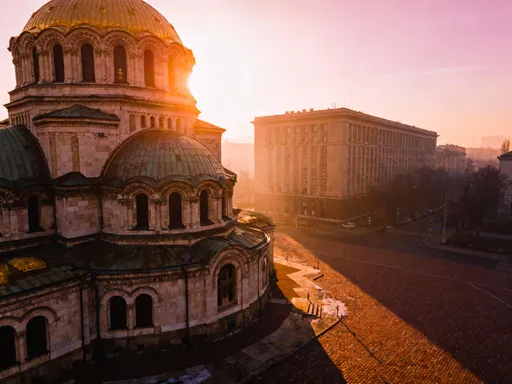
Continue along Maria Louisa Boulevard toward Independence Square, where the neoclassical National Assembly and the Alexander Nevsky Cathedral dominate the skyline. Take time to explore the cathedral’s golden domes and intricate mosaics, then cross to the yellow façade of the Central Mineral Baths, now an art gallery. Walk down Vitosha Boulevard, observing the mix of Austro-Hungarian buildings and socialist-era structures. Stop for coffee at a café with outdoor seating—preferably one housed in a restored 19th-century building—to rest and reflect.
Next, detour into the old bazaar district, where narrow lanes and low buildings evoke the Ottoman past. Look for carved woodwork, arched doorways, and hidden courtyards. Then, make your way to the National Theatre, a masterpiece of neoclassical design, and nearby, the Presidency, with its elegant façade and manicured gardens. End the walk at one of the city’s hillside parks, such as Borisova Gradina, where panoramic views offer a final perspective on Sofia’s architectural tapestry.
For the best experience, visit in the morning or late afternoon, when sunlight enhances textures and colors. Bring a camera, but also allow time to simply observe. Let the city speak. Stop in local cafes that match the neighborhood’s character—perhaps a traditional Bulgarian restaurant serving homemade food, or a quiet tea house in a restored courtyard. This walk is not just about seeing buildings; it’s about feeling the passage of time, one step at a time.
Conclusion: Seeing Cities with New Eyes
Sofia teaches us that architecture is more than style—it is memory made visible. Every arch, dome, and cobblestone carries a story, not just of how people built, but of how they lived, believed, and endured. To walk through this city is to learn a new way of seeing—one that values not only grand monuments, but the quiet details in between. It is a lesson in patience, in looking closely, in listening to what buildings have to say.
For the thoughtful traveler, especially those who seek meaning in their journeys, Sofia offers a profound reminder: the most beautiful destinations are not always the most famous, but the ones that reveal their secrets slowly. By paying attention to contrasts, to silences, to the way light falls on an old wall, we connect more deeply with a place. We move beyond tourism and into understanding.
The real journey isn’t just about seeing landmarks, but learning to read the city like a story written in stone, brick, and light. Sofia invites us to slow down, to notice, to wonder. And in doing so, it doesn’t just show us its past—it helps us see our own present more clearly. In the end, the most lasting souvenirs are not bought in shops, but gathered in moments of quiet discovery, one hidden detail at a time.